
















Good Wednesday,
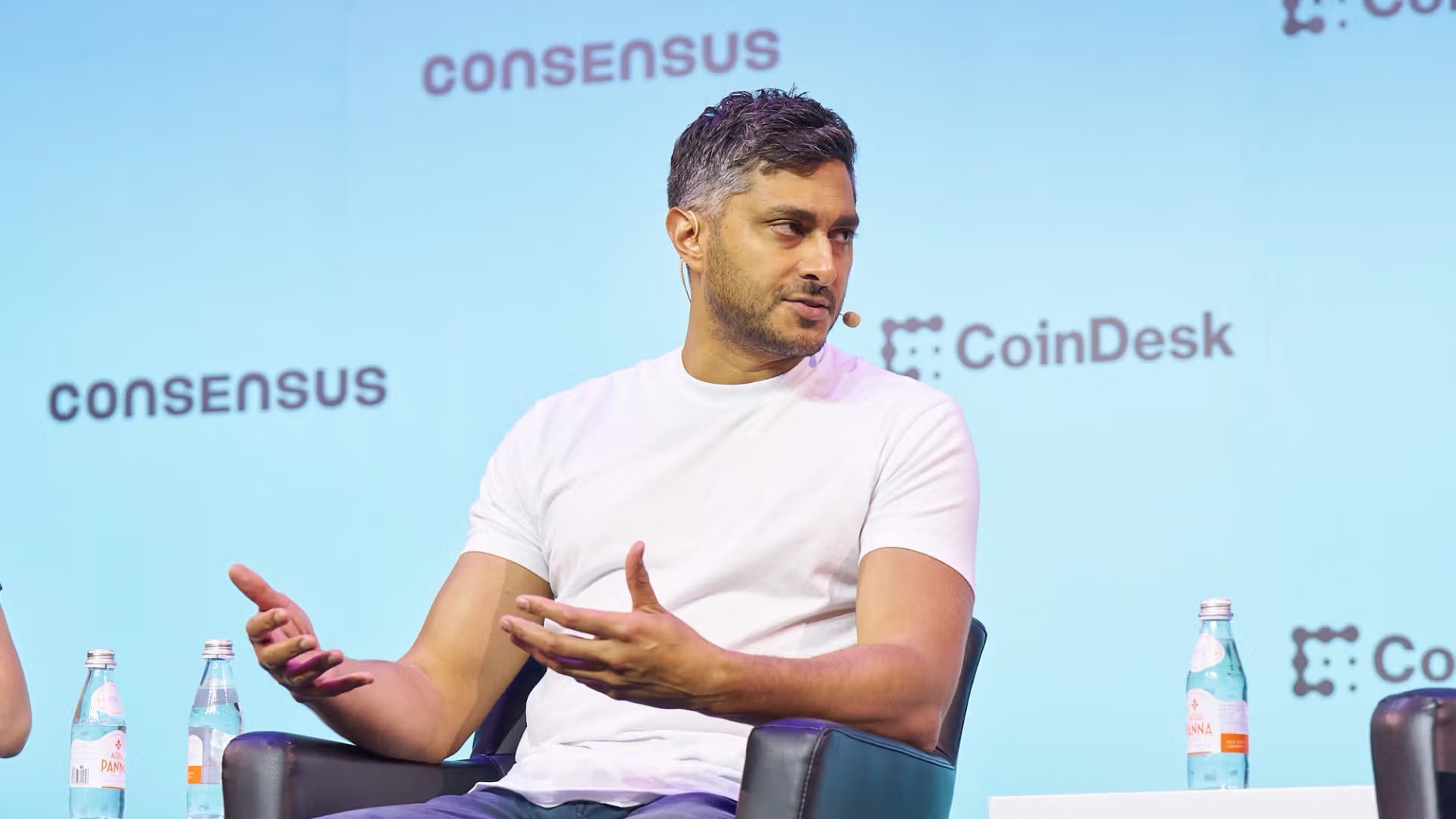
Moon Pursuit Capital's Utkarsh Ahuja discussed what kind of financial infrastructure would be required for an economy composed of autonomous AI agents.
Headline news that institutions should pay attention to
Thank you for reading!
- Kim Klemballa
AI The economy will need a blockchain track

Author: Moon Pursuit Capital – Founder and Managing Partner; Utkarsh Ahuja
Discussions surrounding artificial intelligence have been dominated by a familiar question: which companies will emerge victorious? Investors are trying to identify the next dominant model, application, or AI platform, and they are investing substantial capital in doing so. However, I believe there is another investment issue that deserves more attention: if AI is truly as important as the market expects it to be, on what kind of financial infrastructure will this economy actually operate?
I increasingly believe that the answer will involve blockchain and digital assets. This doesn't mean that every AI company needs a token, nor does it mean that labeling a certain crypto project with the “AI” tag will suddenly create value. More interesting opportunities lie beneath these two fields: autonomous software is beginning to interact with financial systems, and there is a need for an infrastructure that can transfer value as quickly and programmatically as information is transferred.
We are moving towards a world where AI agents will not merely generate text or analyze data. They will negotiate with other agents, purchase computing power, pay for data fees, execute transactions, and manage financial decisions within parameters set by humans. Traditional payment infrastructure is built around transactions initiated by individuals and institutions, and it is not designed for millions of autonomous software agents to continuously conduct small-scale cross-border transactions.
Blockchain infrastructure is very suitable for this environment, as currencies can become programmable. AI Agents can interact with wallets, execute smart contracts, or transfer stablecoins without the need for as much human intervention as with traditional financial infrastructure. Stablecoins are particularly important here, as they provide a bridge between the programmability of blockchain and familiar units of account.
This is where I believe investors should expand their understanding of the AI transaction. The opportunities are not limited to companies that build models or applications. If AI generates significantly more machine-to-machine economic activity, then there will also be a need for corresponding infrastructure to enable these machines to trade, prove identity, establish ownership, and exchange value.
Identity is a good example of this. As autonomous proxy capabilities enhance, the market will need methods to determine who or what is behind a transaction, as well as what authority a particular proxy has to do. The same is true for provenance. When the AI system consumes data, creates intellectual property, or executes transactions, it becomes increasingly important to confirm the source of information and who owns what. Blockchain does not solve every aspect of these issues, but its ability to provide verifiable, shared records makes it a natural component of the infrastructure stack.
I believe there is another often overlooked perspective from the capital market standpoint. Tokenization is already bringing traditional assets onto the blockchain, and stablecoins have proven that important financial activities can be conducted on the chain. At the same time, AI is making financial decision-making increasingly automated. These trends are currently developing separately, but their convergence could be of great significance. An agent that can analyze the market but cannot efficiently hold, exchange, or settle assets AI is inherently limited in its capabilities. Combining programmable intelligence with programmable assets opens up much more interesting possibilities.
For investors, this requires a certain level of discipline, as the integration of technologies does not mean that every project that involves AI and cryptography should be given a premium valuation. We have seen in previous crypto cycles how quickly narratives can outpace fundamentals, and the same risks exist in the current AI sector. I prefer to look for infrastructure that addresses the real issues brought about by higher levels of automation: payments, settlement, identity management, cybersecurity, custody, and the mechanisms that connect traditional markets with digital markets.
I mainly view all of this from the perspective of investors and traders. What interests me is where structural changes create new capital flows and economic activities. AI is likely one such change, but investors should not assume that all value will flow towards the application layer. One of the greatest opportunities may come from providing the financial infrastructure necessary for an increasingly autonomous economy to function.
The Internet has changed the way information flows, while blockchain has transformed the way value moves. AI is now changing who, or more and more accurately, what, can make economic decisions. Investors should pay closer attention to what happens when these three changes collide.
This Week's Headlines
This week's main focus is on traditional finance integrating itself into crypto infrastructure from two directions. Goldman Sachs, without undergoing tokenization, introduced a treasury fund worth approximately $100 billion into crypto institutions through the settlement network used by digital asset companies Lynq. Meanwhile, Cboe Global Markets and the S&P Dow Jones Index have left room for exploring tokenized options under an extended licensing agreement.
Goldman Sachs integrates a $100 billion Treasury fund into the infrastructure of crypto institutionsGoldman Sachs' FTIXX Treasury fund reaches institutional crypto companies through the settlement network Lynq used by digital asset companies, but no tokenization was conducted.
Cboe and the S&P Dow Jones Index may explore tokenized optionsThe newly extended licensing agreements between the two companies leave room for tokenized option products, which once again demonstrates that blockchain-based tools are getting closer to a mature derivatives market.
Buterin Sketching Ethereum in 2030In an article titled “The cryptographic world computer”, Vitalik Buterin describes the combination of blockchain with cryptographic proofs as well as computer networks that operate outside of the chain.
As U.S. Treasury yields stabilize, Bitcoin rebounds above $84,000On Monday, Bitcoin fell to $82,500 before rebounding above $84,000 the following night, as the yield on 10-year U.S. Treasury bonds briefly rose to 5.2% before stabilizing. Spot Bitcoin ETF saw a net inflow of $30 million on Tuesday – which, although not strong, is still considered positive after attracting a total of $2.84 billion over six consecutive trading days in the preceding week.
This Week's Charts
- The clock is ticking: The application window for UK crypto regulation has opened, with a deadline just one hour before February 1st.
- Cardano Selected by Brazil's state-owned oil giant for tracking cleaner aviation fuel and diesel 2 hours ago
- The threat of a stronger dollar to Bitcoin is weaker than traders imagine. 4 hours ago.
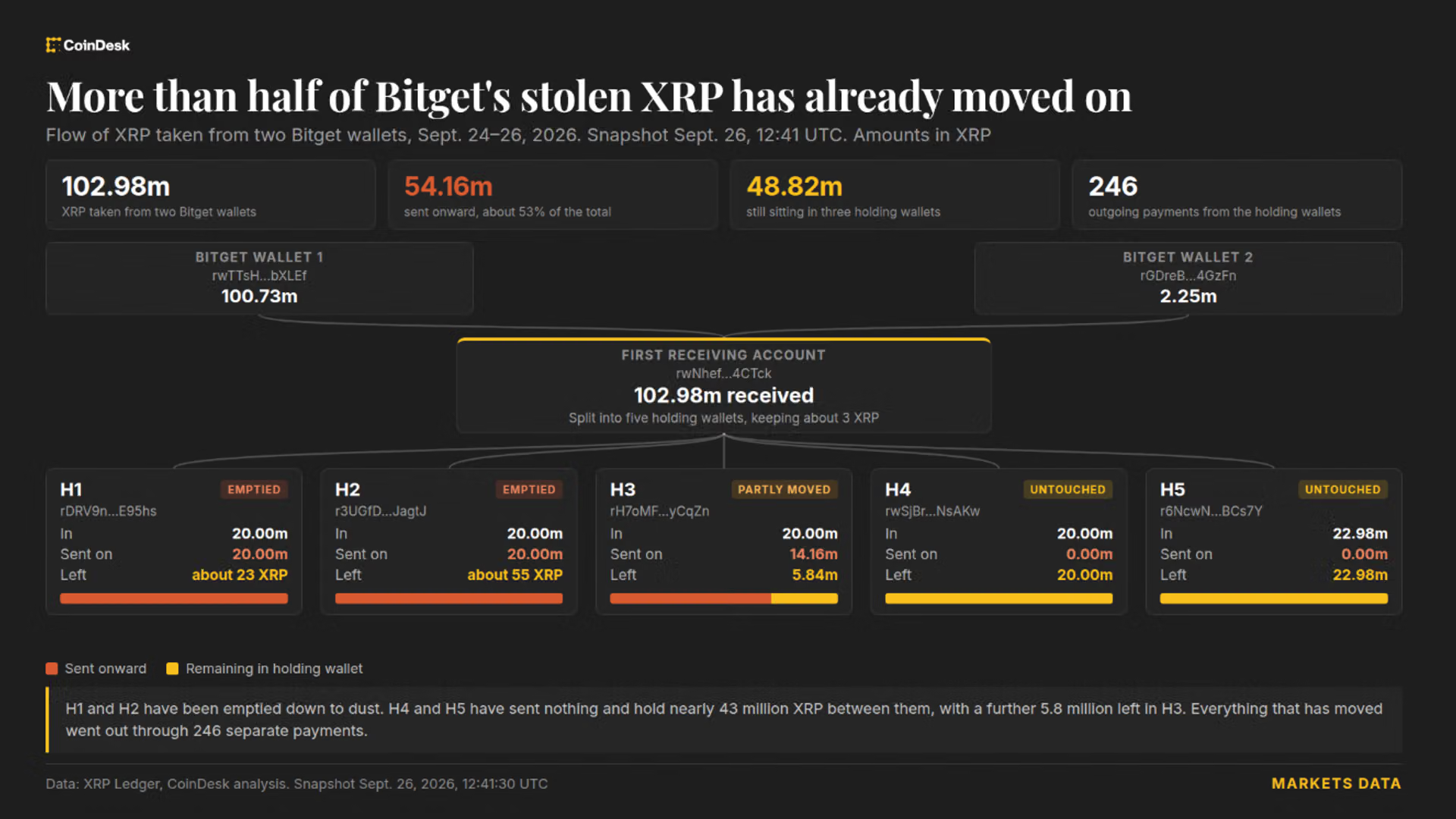
- Bitget Hackers transferred $4 million into Zcash's privacy pool, making it harder to track the funds 4 hours ago
- SEC Finally, modernized transfer agency rules are in place. Wall Street must not repeat the "document crisis" 4 hours ago
- OpenAI, Google, and Meta committed to conducting independent AI security audits under the voluntary White House agreement, 4 hours ago.
- Real-time update: Bitcoin has returned to $84,000, giving back the morning gains from 5 hours ago.
- Under the Robinhood perpetual contract plan, the Lighter decline narrowed by 17%; Bitcoin has been hovering around $83,000 for the past 5 hours.
- 6 hours ago, OpenAI sought to raise $30 billion with a valuation of up to $1.4 trillion after postponing IPO.
Above risk-free rates: Diversified real-world returns in productive stablecoins
Above risk-free rates: Diversified real-world returns in productive stablecoins
Diversification: Stablecoins maintain yields of 5% to 7% through real credit, while the cost of crypto financing has been reduced to around 4%. GENIUS Pushes earnings off-chain; within three years, TAM will increase to $4 billion.
Diversification: Stablecoins maintain yields of 5% to 7% through real credit, while the cost of crypto financing has been reduced to around 4%. GENIUS Pushes earnings off-chain; within three years, TAM will increase to $4 billion.
Why it's important:
Diversification: Stablecoins maintain yields of 5% to 7% through real credit, while the cost of crypto financing has been reduced to around 4%. GENIUS Pushes earnings off-chain; within three years, TAM will increase to $4 billion.
Cryptography for Consultants: The Hidden Costs of Holding Bitcoin
Crypto Long & Short: Inside scoop on the weekly settlement of $150 billion in stablecoins on the blockchain
Cryptography for Consultants: Why Consider Diversified Allocation Beyond Bitcoin and Ethereum