

Good Wednesday,
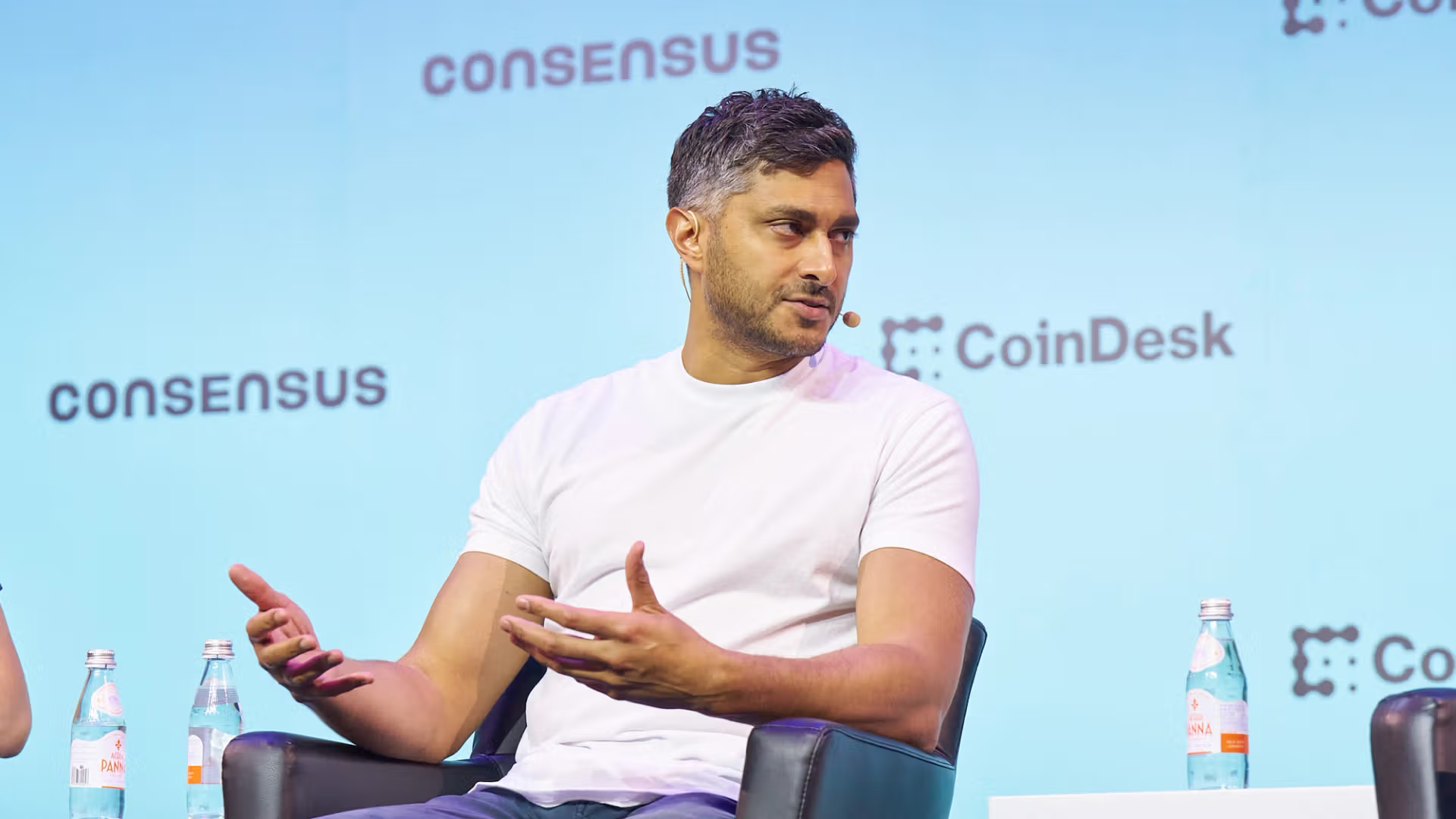
What Steve Neamtz of Yorkville America talks about gold having, while Bitcoin is still in the process of building.
Headline News That Institutions Written by Francisco Rodrigues Should Pay Attention To
This week's charts: " CHIP rebound, USD.AI shifting towards loan factories"
...If you want to see Bitcoin meet Broadway: Cryptocurrencies are taking center stage in New York. The comedy "Bitcoin Bad Boy" created by Ben Schiller will be performed at Chain Theatre from October 15th to 25th. The play revolves around a family deeply in debt, a programmer who wants to build a better world, and a memecoin. Learn more.
Thank you for joining!
- Kim Klemballa
Gold and Bitcoin are allies against currency devaluation.
Author: Yorkville America, CEO: Steve Neamtz
Gold prices are approaching $4,200 per ounce, while Bitcoin BTC remains around $84,000, which has once again sparked a familiar debate: should investors hold gold, or should they opt for alternatives to "digital gold"?
For 5,000 years, gold has proven its value as a reserve asset. Bitcoin, with only a history of 17 years, has much less empirical evidence to support its value. However, the supply of both assets cannot be easily expanded by central banks or fiscal policy makers. Therefore, in a world plagued by debt, their common scarcity becomes even more important.
In the United States alone, federal debt has exceeded $39 trillion. The United States spends about $1 trillion each year just to repay the interest on existing debt, and the prospects for most regions of the developed world are even more challenging. Money often serves as a buffer against fiscal concerns. For example, over the past twenty years, the purchasing power of the dollar has decreased by about 40%.
In this context, it is very important to understand the role of supply-constrained assets in a long-term diversified portfolio. A study from 2025 on Resources Policy used multi-fractal cross-correlation analysis across six categories of assets – stocks and bonds from developed and emerging markets, commodities, energy, and crypto assets – and found that, under rigorous testing, “neither gold nor Bitcoin can be classified as a hedging tool or safe-haven asset in financial markets.”
This finding focuses on behavior during market downturns – that is, whether these two assets can reliably move in the opposite direction to stocks and bonds when the market is falling. It does not indicate whether they can maintain their value relative to a currency that is slowly but continuously depreciating. Investors and asset allocators who buy gold or Bitcoin often do not regard them as buffers against shocks; rather, they are betting on currency devaluation: assets that do not rely on any government commitment to repayments and can provide diversified returns.
In this context, gold and Bitcoin are not competing against each other; rather, they are at different stages on the same track. Gold already possesses the infrastructure such as custody, legal framework, and reserve status, which enables central banks to implement policies of currency devaluation and diversification of reserves today. Bitcoin does not yet have these capabilities—at least not fully.
The leading position of gold reflects the infrastructure that has been built over several decades, rather than its stronger assertion of this logic. Bitcoin has not yet reached the same level of awareness and popularity. It is at an earlier stage on the same curve, rather than on another curve, and it tends to attract a younger generation of investors more often.
According to data from an industry organization funded by mining stakeholders, central banks purchased a record 289 metric tons of gold in the second quarter of 2026, compared to 244 metric tons in the first quarter. Although this purchasing pace has also been independently confirmed elsewhere, it is still worth noting as it most clearly demonstrates where reserve managers are investing their money and why they are doing so. Bitcoin is being bought into the same logic through a newer form of packaging – spot ETF – which solves the custody issue but does not address the issue of sovereign reserve status required by central banks.
There's no need to take a side on this matter. Central banks are buying gold on existing infrastructure; institutions, on the other hand, are purchasing Bitcoin on infrastructure that is still under construction. Both are based on the same logic of currency devaluation, but they are at two different stages. As reports about "currency devaluation transactions" intensified in 2026, financial media began to refer to it as a single transaction, rather than two competing ones. For 2027, the relevant question is not which asset will prevail, but how much of each of these two diversifying tools should be included in a portfolio whose purchasing power is continuously eroding. Given the significant volatility differences between gold and Bitcoin, we believe that a strategy that can help investors determine the appropriate allocation of these two anti-devaluation assets will contribute to improving the effectiveness of portfolio construction.
This Week's Headlines

Author: Francisco Rodrigues
This week's headlines show that institutional crypto businesses are continuing to expand through bank transactions, regulated custody, and national-level ETF access, while European regulators are pushing to remove unauthorized stablecoins from trading platforms.
- The EU requires crypto platforms to remove unauthorized stablecoins within three months: The European Securities and Markets Authority (ESMA) has instructed authorized platforms to prevent new transactions and purchases of stablecoins that do not comply with the Crypto Assets Market Regulation Act (CSAMR). National regulatory authorities are expected to resolve the issues related to existing customer positions within three months.
- Russia's largest bank approved to trade cryptocurrencies: Sberbank of Russia ( Sberbank ) has been added to the country's cryptocurrency exchange registration list and plans to open trading to all customers on December 1st. Bitcoin, Ethereum, and Tether have already been tested within its platform.
- Ledger claims that spy chips in resold devices steal wallet recovery phrases: CryptoBilis Resold signed devices contain concealed implants that can read the recovery phrases on the device screens and send them over mobile networks; researchers on the blockchain estimate that the loss, involving more than 300 wallets, could amount to up to 93.2 million US dollars.
- Thailand opens its domestic stock exchange, allowing Bitcoin and Ethereum to be listed locally ETF: Rules taking effect on October 16 will allow local asset management companies to launch single-asset crypto funds, provided that at least 80% of their net assets track Bitcoin or Ethereum, and the tokens are held by regulated custodian institutions.
- Standard Chartered Bank launches institutional-level RLUSD custody in Dubai: The bank currently holds stablecoins of Ripple for eligible customers and plans to integrate these holdings into LMAX, allowing them to be used as trading collateral without leaving the bank, subject to approval and completion of testing.
This Week's Charts
CHIP rebound, USD.AI shift to loan factory
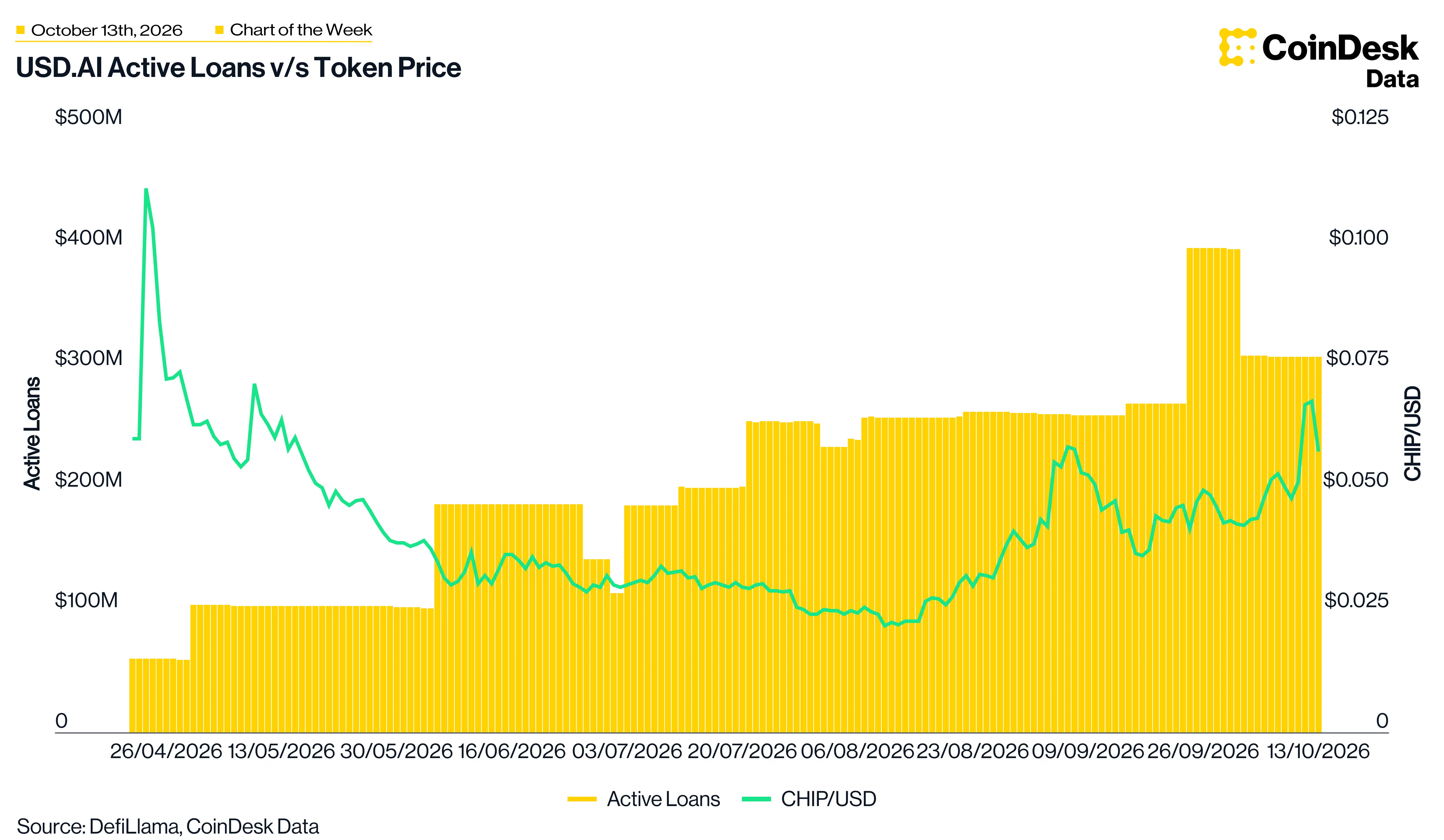
As of October 2, the active loans of USD.AI decreased by about 22% to approximately $311 million, and have remained stable since then; meanwhile, CHIP has rebounded by about 35% since October 1 to around 5.8 cents, but is still about 48% lower than its peak in April. The driving factor is GLX, a "loan factory" model (issuing loans, selling the performing loans to institutions, and recycling capital), which may contribute to the recovery of active loans by reinvesting capital into new loans without significantly expanding the balance sheet.
Other headlines this week
- The BlackRock crypto ETF asset has surged by 63%, but it is still far below the peak in 2025.
- The person in charge of FTX Europe takes advantage of the new exemption provided by SEC to target tokenized stock trading in the United States.
- The growing digital economy in the United States requires an upgrade of the power grid. Who will foot the bill?
- Kraken's parent company, Payward, will become the first crypto company to acquire a bank in the EU, continuing to expand its deposit and lending business.
- U.S. data on CPI in September was relatively strong, leading to a significant decline in Bitcoin prices.
- How Analysts View the Impact of U.S. Inflation on Bitcoin
- The Dutch Central Bank issued an electronic currency license to Qivalis for euro tokens that comply with MiCA.
- Before the release of U.S. inflation data, Bitcoin remained above $83,000, while altcoins performed poorly.
- S&P 500 options have become the hottest bet on the Hyperliquid exchange
Beyond risk-free rates: Diversified real-world returns in productive stablecoins
Beyond risk-free rates: Diversified real-world returns in productive stablecoins
Diversification: Stablecoins maintain yields of 5% to 7% through real credit, while the cost of crypto financing has been reduced to around 4%. GENIUS Pushes earnings off-chain; within three years, TAM is expected to grow to $4 billion.
Diversification: Stablecoins maintain yields of 5% to 7% through real credit, while the cost of crypto financing has been reduced to around 4%. GENIUS Pushes earnings off-chain; within three years, TAM is expected to grow to $4 billion.
Why it's important:
Diversification: Stablecoins maintain yields of 5% to 7% through real credit, while the cost of crypto financing has been reduced to around 4%. GENIUS Pushes earnings off-chain; within three years, TAM is expected to grow to $4 billion.
Encrypted content for advisors: Digital assets outperformed stocks and gold in the third quarter.
Crypto Long & Short: In the era of AI, the significance of Zcash and privacy
Cryptography content for consultants: CLARITY The bill failed, but the rules have still come into effect.
The BlackRock crypto ETF asset has surged by 63%, but it is still far below the peak in 2025.
The person in charge of FTX Europe takes advantage of the new exemption provided by SEC to target tokenized stock trading in the United States.